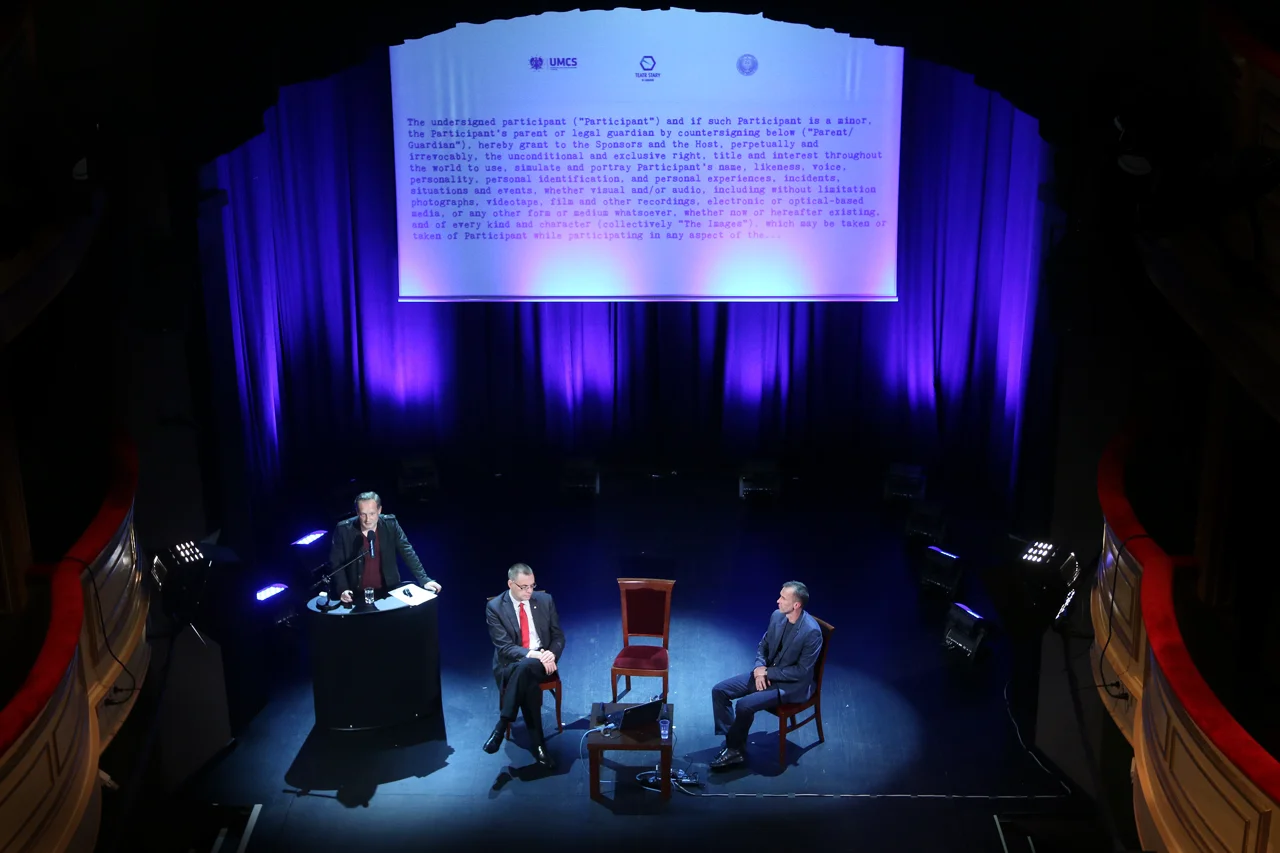
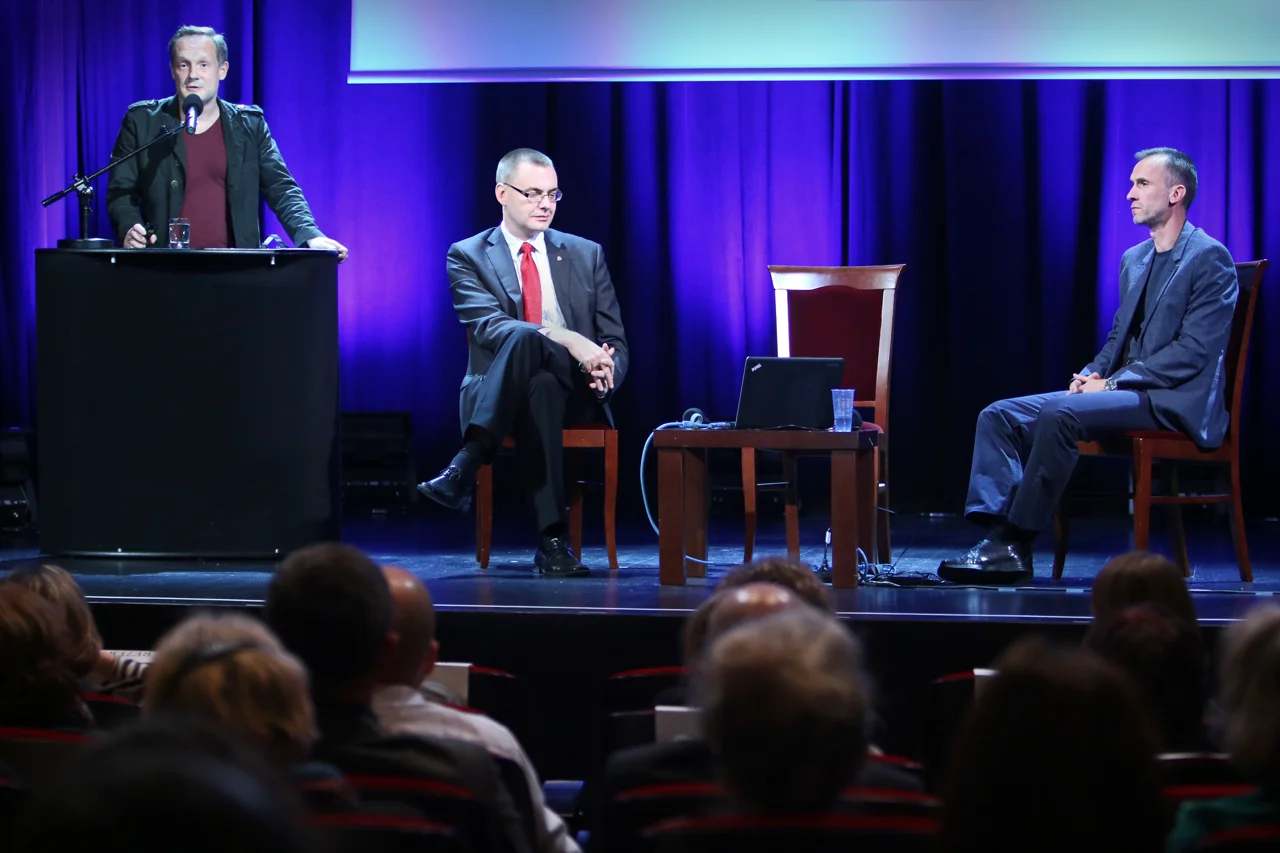
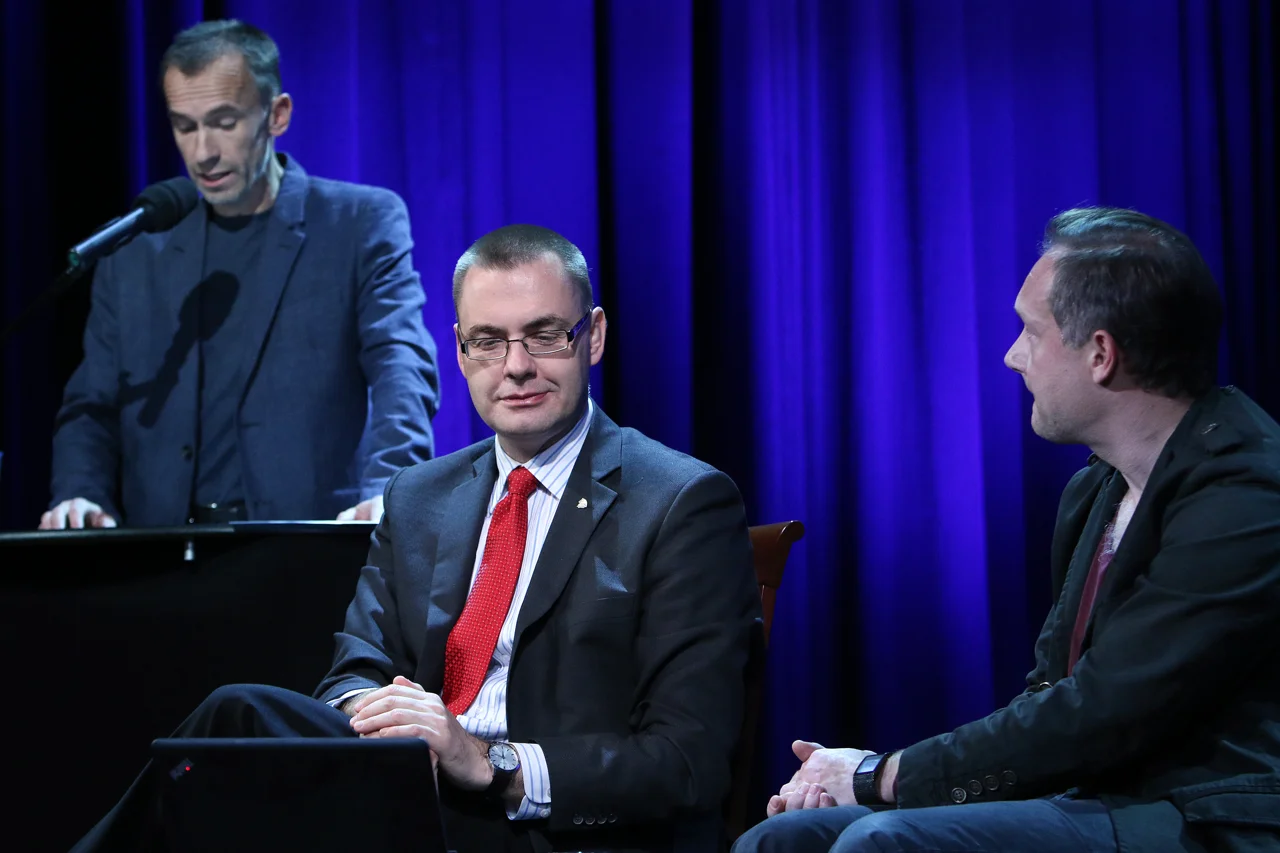
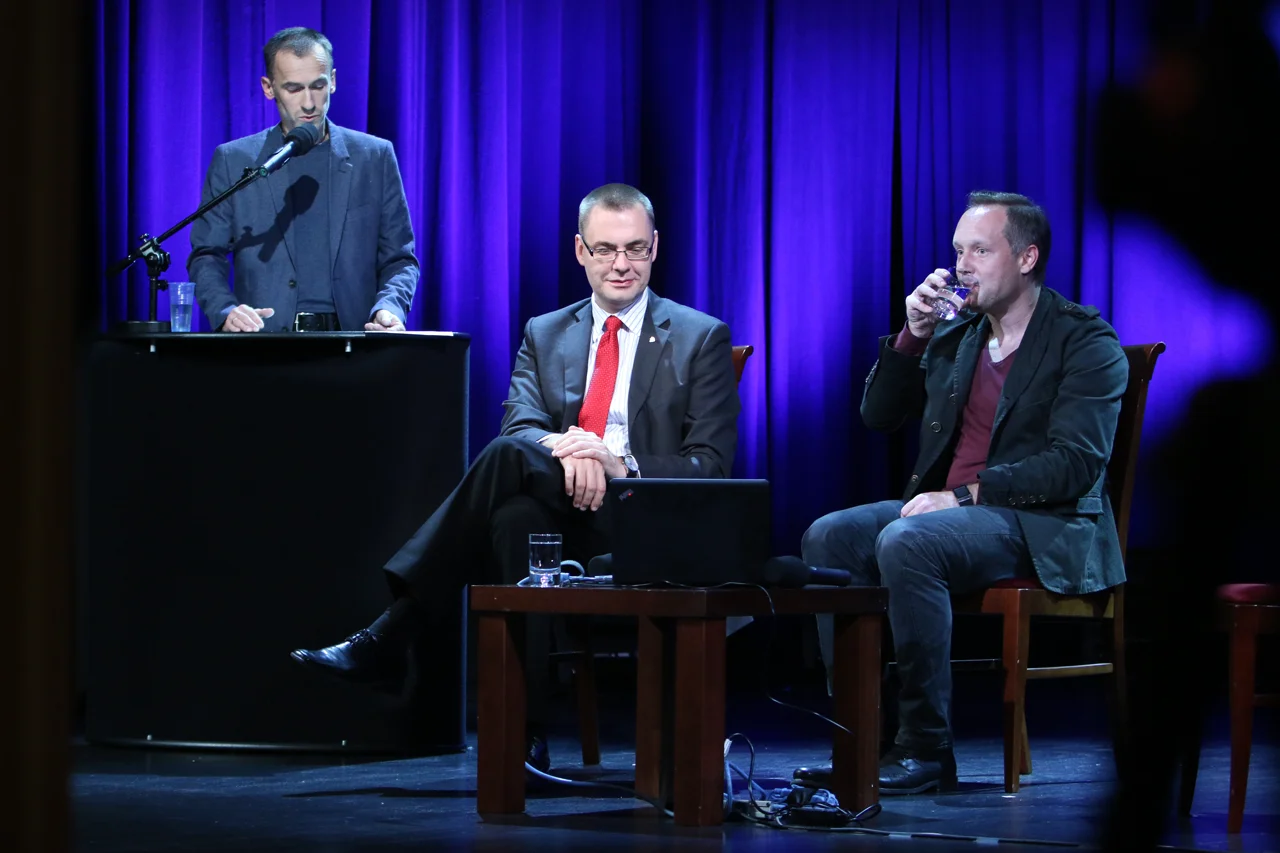
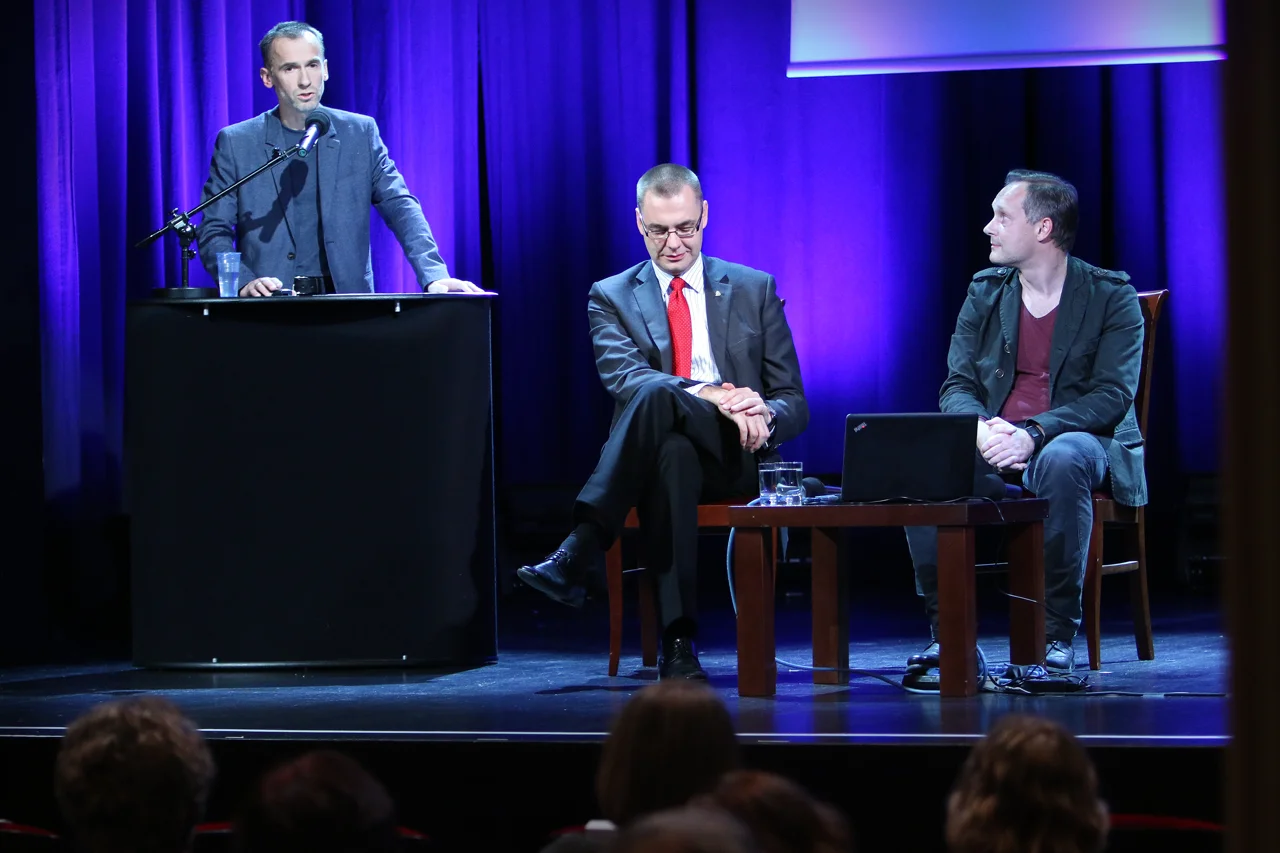
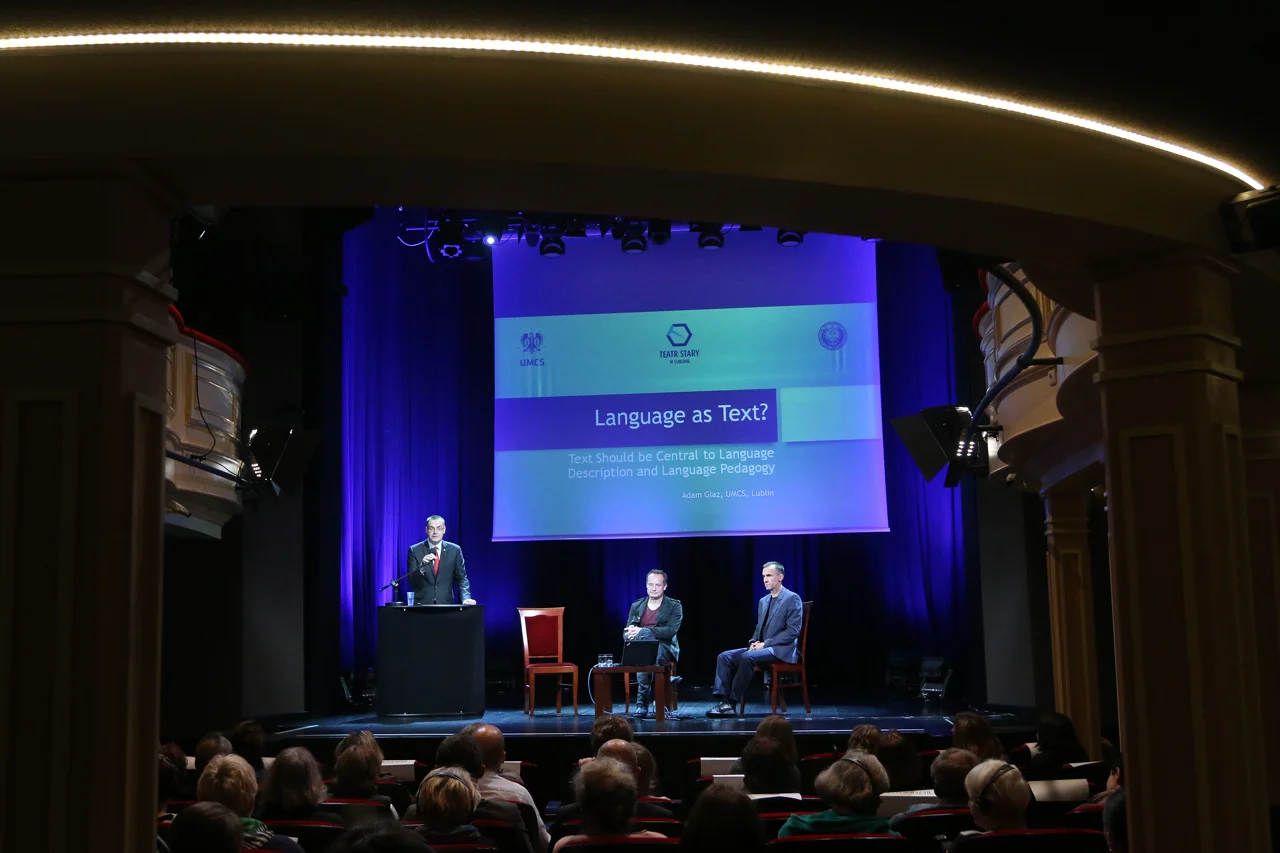
[00:11.20 → 01:01.87] A: All right, I think we are all set. So it's a great pleasure to welcome you to this beautiful building, the old theater. And it is my pleasure to be moderating this debate that is going to be held this evening. And the motion, as you can see on the slide, is text should be central to language description and language pedagogy. We have two scholars, two specialists in the field. One of them will be arguing for the motion, and the other will be arguing against the motion. One of them is Dr. Peter Steinbrick, who will be arguing for the motion, and actually against the motion. I'm so sorry. And Adam Glass will be arguing for the motion. I forgot to introduce myself. My name is Miroslav Pavlaks, and I'll be moderating the debate this evening. Thank you so much. So, Adam, may I just pass the floor to you? Thank you.
[01:10.19 → 01:16.83] B: Thank you, ladies and gentlemen. Mr. Chairman, dear colleagues and friends,
[01:19.22 → 01:19.50] C: it's
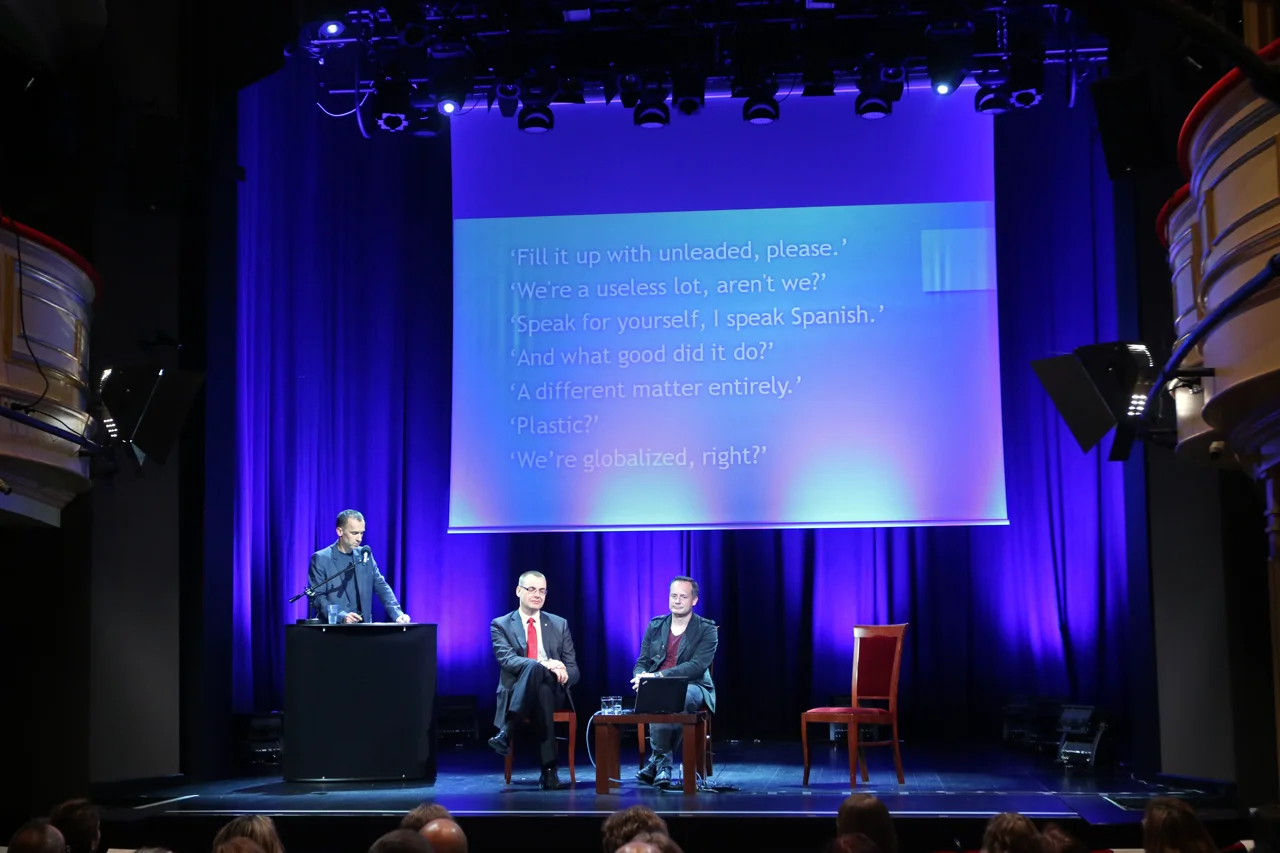
[01:19.50 → 17:18.66] B: a pleasure and honour to be here. Thank you for inviting me. I consider it a privilege as well as a challenge. Now, I once had a chance to listen to a colleague reporting on his rather interesting linguistic experience. He was a participant in the following exchange. It's not working. Okay, that's the exchange. Fill it up with unleaded, please. We are a useless lot, aren't we? Speak for yourself. I speak Spanish. And what good did it do? A different matter entirely. Plastic. We. Globalized. Right? Now, when you look at it, you cannot help but feel somewhat bad. Baffled, to say the least. This is an actual stretch of conversation occurring in real life situation. In other words, this is a text, of course. It's spoken rather than written. It's discursive, dialogic, and conversational rather than monologic. And it's unpremeditated rather than carefully structured and planned. But it is a text nevertheless. I like to think of this exchange as text because it rather well illustrates the point I'd like to make. Namely, that it doesn't make sense. Doesn't make sense. Maybe it makes some sense, but not totally. I wonder if there's anyone here for whom it makes global sense as a whole. If there is, I congratulate you. And I rather wish I could boast the same linguistic and intellectual capabilities. Now, of course, the matter is simple. It doesn't make sense because A, we don't have access to the context of it all, and B, there's a difference between text cohesion and text coherence, which is, after all, what linguists have been discussing for decades now. This means that in order to understand it, the Factors of text internal organization prove insufficient and we need to go beyond what's given in and as text. And we need to go beyond in two directions. I wonder why it's not working. Okay, thanks Peter, for helping me out in this one. We need to contextualize text, Or rather to allow the context to infiltrate the textual given. And we need to account for what happens in the minds of the interlocutors or in the mind of the reader. Click again please. One more time. So we have the interlocutors in the case of spoken exchange, or the reader who has to make some sense of what he or she is reading. Contextualization is often relatively easy. An account of the speakers minds usually very far from it. But let's try the context. Here is the the conversation takes place in England at a filling station, as you can guess from line one between a customer and worker. At that station. The worker happens to be listening to a radio program where it is said that the English are notorious for their poor commands of foreign languages as well as for their unwillingness to learn them. Once they had built the British Empire and dominated the world, they can enjoy the luxury of English as a global language. Now the customer, an Englishman, happens to be a Spanish teacher, so he is living counter evidence to that claim. Now, equipped with this knowledge, we can reconstruct what is being meant in the exchange. Please click ok, go again. Thanks. Thank you. Mm. So the line number one, fill it up with an edit please. It's rather obvious. It sets the frame or a scenario of a filling station procedure, but the scenario is immediately broken. In line two, the worker responds, we are a useless load, aren't we? And there is no reference to a car fuel or anything to do with automobiles. In fact, when you think of it, it's not the most polite response to the customer's request, but the worker is relating to the content of the radio program that both he and the customer can hear. Indeed, the worker probably expects the customer to agree, but surprisingly, no such thing. The customer says, speak for yourself. I speak Spanish. It's only natural for a Spanish teacher to respond in this way. And then the worker goes, and what good did it do? And now enter text structure. The requirements of cohesion tell us that the anaphoric it must relate to something that's already been mentioned in previous discourse. And the natural candidate for this is the fact that the customer speaks Spanish. This would again render the response somewhat impolite. And in fact the worker relates to something else, to the British Empire that's being mentioned on the radio, to which the customer appropriately responds. A different matter entirely. A shift of focus. The customer is shifting the focus from language to politics, social issues. It's a long story with the British Empire, and one that is worthy of a separate discussion. And now comes the surprising plastic on the part of the worker. Now again, he shifts focus here now to the immediate context of situation. Malinowski must be overjoyed. And the meaning is, do you want to pay with a credit card? To which the customer says, we globalize, Right? Which is supposed to mean something like, yeah, sure, nothing like a credit card in this day and age. I hope that makes much more sense. The problem is interlocutors access and manipulate these nuances of context and codex easily and quickly. Whereas analysts, linguists, sometimes really have to scratch their heads to arrive at an understanding, let alone an appreciation of a linguistic sample of this kind. Which is probably why, on balance, focus on text in both language analysis and language pedagogy, has been less pronounced than focus on, say, the sentence, and which is why interest, intention, processes, va die chomsky have by extension been postulated as the basis for understanding textual processes. In other words, the claim is that if there is anything in text that involves text structure, it both follows from and is regulated by the same principles that govern sentences. Grammar, in the sense of sentence grammar, is thus the driving force behind text generation and processing. In this approach, language in use is reduced to a closed structure. This, I'm sure, is wrong. This is wrong. And it's wrong, because text and language in general is much more than a closed structure. Certainly it is easier to operate with sentences or the language system. In language pedagogy, most of us here, either experts in second language acquisition or foreign language teachers, or both, and as teachers, we obviously want to ask ourselves, how do I teach linguistic behavior of this kind? Do I want to do that in the first place? If so, why? Or why not? And what for? There are ways of doing that. But it's anything but straightforward. And it isn't straightforward, because we must account for a triadic relationship between language as system, the linguistic sign, and the actual text. A lot of questions here. Is language a system of signs that constitutes a potential for the emergence of texts? Or is it the reverse? In other words, are texts possible because the system allows them to be so? Or are they prerequisite for the existence of language system, which is a mere abstraction that's derived from text in use? Furthermore, what does it mean for a text as a whole to be meaningful? That is, is it composed of smaller size, roughly speaking, words bottom up? Or do we only recognize the individual words as meaningful because they function in a holistically meaningful text as the unnatural environment? It is because of factors like these that I side with those scholars who view text as an entity with its own peculiar characteristics, irreducible to those found on other levels of language. And there are some very fine scholars in the lot. Grammar is thus assumed to be secondary and emerging from discourse, something that becomes entrenched through usage and text creation, says Tommy Givon. Text has its own macrostructure properties that sentence grammar cannot handle. That's Van Dyck. Indeed, to say that a text is well formed or natural is not necessarily to assign the same degree of naturalness to its elements in isolation. That's John Sinclair. The exchange we've seen is perfectly natural. It's a stretch of actually occurring discourse in context, but it's not possible to account for its naturalness as a composite of individual utterances. Finally, we have the famous intertextuality. The names of Julia Kristeva, Ron Barthes come to mind. Intertextuality involves both conscious and subconscious references to other texts or text types, which means that texts don't function in isolation but in networks of relationships, and these networks are in people's minds. Therefore, this triad of language system, linguistic sign, and text is insufficient. Next slide. Thanks. Text meaning extends beyond the verbal expression onto reality, but it is a reality that is experienced and interpreted by us. As speakers, writers, hearers, and readers, we create mental worlds that texts relate to and interplay with. These worlds function in culture as inherently cultural entities through which we both construct and express our worldviews. Texts, or more broadly, utterances, only exist because human beings exist and make them happen, with their baggage of experience, intentions, interpretations, categorizations, stereotypes, prejudices, preferences, you name it. That baggage is soft. It's malleable and intersubjective at best. So text meaning is not to be found in the text itself, but in how the language user interacts with it. So it is not something that is, but something that happens, as some authors claim. A text comes into being in the event of its reading. And most crucially, speakers and writers are creative. We not only represent the world through the texts we produce, but also construct and change it. Grammar More broadly, language system isn't creative. Speakers are to account for what is usually called the creativity of language. We must in fact account for the creativity of speakers who are cognitive, cultural, ergo, largely unpredictable beings. Given all this, it is not surprising that texts are scary Both to analysts and teachers. For how does one deal with all these variables in a systematic manner? And we want to be systematic, don't we? But fear not. Fear not. Despite all these difficulties, I'd like to forcefully argue for a triple yes. Thanks, Peter. First, yes, text must be central to language description and language pedagogy, because it is central to language. As we go along our lives, we function thanks to and communicate in texts of all sorts, spoken or written, spontaneous and premeditated. Short, one word texts, like the stop sign that we discussed this morning at the conference, or long ones, like novels or encyclopedias. Texts and discourse are what we produce and receive, what we understand and interpret. This is what organizes our lives. Texts and discourse are also central to language change. The language system could not and would not change if it were not subjected to pressures of usage that ripped apart its apparent rigidity. Shakespeare introduced into English dozens, possibly hundreds, of words and expressions through text. It was his outstanding dramas that functioned as carriers of linguistic invention that would have otherwise gone unnoticed. So that's the first yes. Second yes, is that text? It is true, text does involve more than the words in it or on its surface, but so does language as a whole. Consider a sample. It is possible to split it into separate utterances and analyze those in isolation, but it will tell us nothing about that which lies at the heart of the dialogue. And the third? Yes, text is an elusive notion, and to deal with it is to invite trouble. It is to invite trouble. Yet to deal with it we must. It must be central to what we do with language. For if we don't, who will? Thank you.
[17:42.83 → 21:11.82] D: All right, thank you very much. You know how to make other person's life tough. Thank you very much for coming to the debate. My name is Piotr Steinbrich and I have chosen to speak against the motion. And I have to say I've been nervous all day for at least two reasons. Reason number one is that I knew I was going to speak after Adam, and I've known him for what, 25 years, and I know what he's capable of. And the second reason is that it came to me that I have been very unwise because I've chosen to speak against the motion saying that texts are not that important to the people who have come here specifically because they like texts. So that makes my evening rather tough. But I like them. I like texts. I think texts are very, very nice. Again, I'd like to thank Adam for what he was saying in his part of the debate, because it reassured me that as teachers or language practitioners or academics, we should not be dealing with something which is basically undoable. With so many parameters in mind, with the most difficult parameter being the speaker's brain, it's simply impossible to come up with something that is systematic, something that can be formalized, and something that is repetitive or should be repetitive. I said I like texts because, as you can see on the following slide, we're surrounded by them. Lots and lots of different texts that we're dealing with on a regular basis. Spoken texts which are absent from the slide. But you can hear me. I'm just providing a spoken text at the moment, and lots of different written ones, like emails, if you can. If you can read what's written on them. But these are texts of different kinds and different calibers. I could be cheap. And to all the arguments that Adam has raised in his part, I could just use those four. Syntax, phonology, morphology, semantics. And that basically does it, doesn't it? Dealing with linguistics. We know that linguistics is basically a sentence, that it's sentential. And most of us recognize the gentleman on your right, Mr. Noam Chomsky, and there have been generations of people familiar with John and Mary and the life story. It was Mary who John saw. Mary was loved by John. It's a tragic one, but we recognize all of those sentences. This for us is.
[21:12.22 → 21:12.62] B: Was.
[21:12.94 → 39:05.75] D: Has been linguistic analysis, the analysis of language, which is doable, which perhaps does not look at all the peculiarities of language. But why deal with something that is impossible? So in attempting to address the motion to be against it, we have to ask ourselves probably the most important question, and that's what is text? Or what are the criteria of textuality? Is text definable in the first place? If everything is text, as Adam was trying to suggest, then what isn't? If everything is text, then why would we call it text in the first place? It wouldn't need a name. Is this a text? Well, it could be. Is it analyzable? Yes. You could say it's two morphemes. You know, it's phonetic or phonological structure, you know what it means, but what you don't know is the context in which it was used. And obviously, when you see that you're trying to create the context or you're trying to extend the context, as Widdowson puts it, because you don't know it. So you're trying to interpret the sentence, but you're trying to interpret the sentence or text using your own modality. And if there's. I'VE been told about 70 people in the audience today. There would be 70 different interpretations of it. There are 6 billion people in the world. If we showed this text to all of them, we would have 6 billion different interpretations. Is it possible to generate something that makes sense on the basis of 6 million? 6 billion. Excuse me, different interpretations? It could mean a lot of different things. For example, sorted would be used in that context. Just finished a presentation and I'm just mumbling to myself. Sorted. I could use in another context, ending an argument with a friend and then consoling him or her, as the case may be, or finding a solution to a problem and sending a text to a colleague or a friend. And these are just three possibilities. And as I was saying earlier, there could be many, many more, because each of you could interpret this particular one differently. So if we look at the notion of textuality, if we look at what is available to us at the moment, when we talk about text and the possible renditions of what the concept of text amounts to, first of all we look at cohesion. Can we talk about cohesion? Is the word sorted related to anything else in this text? Well, it isn't, because there's nothing else apart from sorted. So it can't be linked to anything because you can't link something to nothing. Coherence, the same thing. The text is extremely coherent, isn't it? Because it's not a text, it's just one word. Is it informative? Well, to a certain extent it is. Semantically, we know what it means. Another notion, the notion of intertextuality. Well, probably it's there because we can relate it, but we're relating it not to other texts, but we're relating it to other experiences that we are familiar with. So can we say that our experiences are text or part of text? I'm kind of skeptical, really. This is a text. This is a nice one. If we look at that, if you read it, if you can follow it, probably Ronaldo's contract from Real Madrid or something, it looks like it, at least. But here we can talk about all those criteria that make a stretch of language text. It is intertextual, it is coherent, it is cohesive, it is informative, it's more than informative. And it meets many other criteria that amount to textuality. Again, I'm going to refer to those single individual words that some erroneously refer to as text. Rubbish. Again, if you know the context, you can somehow interpret it, but typically with just one word, we're extending the context rather than referring to something that's given. And we could rephrase it using a number of different possibilities. For example, instead of saying rubbish, we could say, I disagree with you. Is that text? I don't know. We could say, yeah, you're right, but using the more conversational modality, or go for something like that. Not really natural as a stretch of language, but something that definitely shares the features of textuality. Another example, you can imagine a situation, There's a party, and if you see that, you know what it denotes. Excuse me, do you mind if I have another of these delicious chocolates? Another text. Something Scott would enjoy, I believe. Godavo Coba. All right. If I help myself to another of these chockies? They are pretty spiffy. Is that text? I want that one. Is that text? Well, we need the context, we need the code text in order to interpret it, but it's far from being text. Another important question in the course of this debate is why we use language in the first place. And typically, layman's answer to that would be that we use text in order to communicate certain ideas with other people or to interact with something that we read, something that we hear. And if you look at this picture again, probably a number of different ideas will spring to mind. Something that may be said to be the basis for text creation. There's a lady, there's a baby in the pushcha. But there could be lots of different reactions to it. What I'm trying to illustrate with this one is the importance of context and how context and how one's attitude refers to the interpretation or text creation. You could just say cute. So that text, you could say this to that. And that is text, isn't it? The female progenitor is asking a young person in a small wheeled vehicle if some hygienic measures are required to render him more comfortable. So perhaps a more important question than what is text? Is where is it? And as Adam rightly noted, it's here. It's in the brain. We're creating it as we speak. We're creating it as we write, but also we're creating it as we read something. We're creating it as we listen to someone or something. So the question which I think will be open to debate is whether it's possible at all to describe, to formalize something that resides in a human's brain. When we talk about understanding something that we hear or understanding something that we read, or producing spoken text, producing written text, these are not linguistic processes. These are cognitive processes. And when we talk about cognition, we're talking about culture, we're talking about the situation, we're talking about the social aspect, we're talking about the linguistic aspect. We're talking about one's abilities to understand or to express something. There's a lot, a lot of parameters that we have to consider which make it impossible to interpret or to formalize something that we refer to as text. On the other hand, we use language in order to understand something. We use language in order to produce something. And the linguistic part of it is decoding and coding, using your grammar, using your vocabulary, making sentences and gluing them together. And this is something that is doable, this is something that is possible to describe. You know, my heart is much closer to second language acquisition or language teaching and language learning than linguistics per se. So obviously, I wouldn't be myself if I didn't show you any evidence from second language acquisition. And again, I would like to start with some classics. If we look at the history of second language acquisition, what do we get? We get sequence of development. What are they? How learners of foreign language deal with negation, example, what kind of problems they have with relative clauses. It's all grammar and vocabulary. It's not really about text or about how learners handle text. We're talking about accuracy orders, which is similar to sequences, to the sequences of development. Everybody would be familiar with the natural order hypothesis by Stephen Krashen. And again, it looks at individual components of language, and if put together, they would constitute text. But the text, as I said before, resides in the brain. What is central to language pedagogy and language description, again, is grammar. This is something that organizes our lives, if you like it or not. And it's always been like that. It's always been like that. And it's been made even stronger by Bloomfield back in 1933, where he came up with the idea of sequencing. And basically he was saying that while learning foreign languages, we have to focus on structure first, and we have to go from simplest structures through to more complex ones. And if you open any course book for teaching or learning foreign languages, any foreign language, you will see that the sequence is pretty predictable. You will see that all the material in the coursebook will be centering around the grammatical syllabus, that the grammatical syllabus will be the driving force for what's in the book. So if we talk about English textbooks, probably we'll start with present continuous for actions happening at the moment of speaking, like I'm talking now, for example, it could move to can for expressing ability. Like, you know, I Can speak seven different languages. For example, present simple could be next. Past simple follows. Past continuous, present continuous for future arrangements. After we've done the past tenses, then the second conditional, then wish, and so on and so forth. It's a predictable sequence. And as I said before, you open any course book, this is what you get. It's not text orientated, it's not vocabulary, even though it's grammar orientated. Is it natural? I'm not so sure if it's natural. Is it helpful in creating texts? Definitely. But to what extent? It's a good question. Present continuous for actions happening now. I'm speaking, I'm standing. You're sitting, you're listening. If I was speaking to you like that, you'd probably think, what is he talking about? It doesn't make sense. If I said to you, I can speak seven different languages, I can play the guitar, you think he's a pompous prat, we're not talking to him, and so on and so forth. So if we're looking at that from a different perspective, if looking at that from the perspective of the possible text creation, that is usefulness, that's what we get. And that's based on my mini research. I used the British national corpus and I wanted to check which structures would be more frequent than others. And as you see, the past tense rules. You can't survive a day without talking about the past simply. Then we've got present continuous. But for future arrangements, we like talking about the future. Then we've got the second conditional. We like wishful thinking. Hence wish comes next. Past continuous, present simple, past present can for expressing ability is very low. So is present continuous for actions happening now. And I bet that if you saw a course book with this sequence, you would think the author was absolutely crazy and lunatic and you would never use it because it's ingrained in us that grammar is central, that grammar and vocabulary are the basis for text creation and not vice versa. Just to give you a few more examples, one of the classics, a book by Hornby, the structural approach from years ago. A nice table that shows the students how to form certain grammatical structures. My favorite one is Deck. I think you can't probably see it, but it reads, how many legs have I? And again, if I ask you that question, you think there's something wrong with me? Oh, you probably can't see. It would make more sense if you could see that I've got two legs. But this is something you could possibly predict as well. But we probably wouldn't expect any Student to go around London asking strangers, how many legs have I? Students are not replicating text, they're creating them. But obviously, as I said at the beginning, this is not a text. This is just a basis for it. Adam showed a very nice dialogue at the beginning and at the end of his presentation, I would like to finish off with a dialogue as well, also from a rather dated book. It's not just Scott who likes them, I collect them as well. John and Mary, you're familiar with, aren't you? They've been used in linguistics. They've been used in language teaching as well. This is taken from one of the course books from the 60s. And it's a text, isn't it? It's a text between John and Mary Brown, who are a couple. What are they talking about? What kind of text? Does it make sense? Is it a better candidate for a text than Adam's text? Is it similar? Possibly it is. You read it and you try to make sense out of it. Why are they saying what they are saying? I'm a man, you're a woman. I've never said that to my wife. Maybe I should. Is this a book? Yes, that is a book. Is this a door? No, that is not a door, it's a pen. Because people typically confuse the two, we are not expecting the learners to replicate it. They would assimilate it and they would do whatever they want with it. They would be text creators themselves, not the course, but writer, not the teacher. It's the users, it's the learners. You haven't seen the final lines of this dialogue? Which favorite lines? My favorite two lines. You see, the conversation starts with John saying, I am a man, you're a woman. And to provide a nice textual framework for this, John finishes the conversation in a following. Am I a man? Mary? And then Mary says, yes, John, you're a man and I'm a woman. So to finish off, I think texts are nice. I like them, I use them, I react with them, I interact with them, read, listen. But I don't believe that they should be central to either language description or language pedagogy because I don't like the tasks which are simply undoable. Texts are nice. Thank you very much.
[39:11.51 → 39:12.07] E: Oh my.
[39:12.07 → 39:42.49] A: I'm speechless. Okay, so thank you so much for the two excellent presentations and we've heard a number of compelling arguments and thought provoking arguments and well, a number of controversial issues have been raised. And well, we'd like to start the debate, but we would like to do away with formality. So it's not that you're supposed to address only the speakers, but in fact, only interactions among each other. So it is my job to open the debate, and it's your job to do the rest, I would imagine, together with the speakers. So please do so. The floor is open to discussion, questions, comments, and the debate. Thank you.
[39:45.85 → 39:51.69] D: And I've got. I've got a spare microphone. Actually, I've got two spare microphones.
[40:03.94 → 40:38.66] F: Somebody has to go first. I'd like to take it down even to a lower level than the level of a sentence. I think language is about communication, and I think people start communicating at a level which is not even a sentence. If you think about that mother talking to the child, or if you think about a person talking to an animal, or you think about two very small children talking together, they're communicating. But what they're using is certainly not a text. It's a communication, it's an utterance, but it's something different.
[40:47.46 → 41:10.91] D: All I should say to what Melanie said was, mm, agreed. But I think it grows with the speaker. If we're talking about children, they begin to learn the system in a different way than learners or the students of English. But it definitely grows. And I know what I'm talking about. Believe me, I'm a father.
[41:12.99 → 42:36.19] B: This is a nice comment, but it again begs the question, if it isn't a text and something different, what is it? What is it? I mean, of course it's easy to put a label on it. It's an utterance. It's. I don't know, some kind of expression that the person uses for a particular purpose. And we've. Was it today or was it yesterday at a conference? I forget that Halliday's notion of text as something functional was evoked. If it has a function, then it qualifies as a text. Of course, we may say we arguing semantics here and just, you know, flipping labels back and forth. What I'd like to argue for is that there is no big functional difference between a text that composed of. Of a single word and a text that is composed of a number of sentences. Of course they have different structures. Of course, the notion of cohesion is different in each case. You may say it doesn't exist if it's just one word, but the function, the actual job that it's supposed to do. Well, these are at least comparable. That's why the notion of text can be used in references to both.
[42:41.04 → 42:43.76] A: There's a question down there or a comment or.
[42:44.32 → 42:45.12] G: Right. Hello.
[42:45.92 → 42:47.08] A: Okay, you got the mic right.
[42:47.08 → 44:31.43] G: I'm Sorry, he was sneaky about. He just gave me the mic while the comment was going on. Right. I listened to both presentations and they were kind of on a more or less similar topic, as it were. Motion. But I'm still. It still eludes me what exactly we are trying to achieve besides the very pleasant academic exercise and the enjoyment of the presentation. Because at first we were discussing something fairly theoretical. What is text and what is it for? And if everything is text, as it were. I'm just kind of shooting questions. And then we went somewhere more practical, as it were. Should we, when we teach a language, should we give the structure or should we have the learners interacting with text? And what is text in the first place? And then we had the first comment which made a very good point about employing drama in learning a foreign language because communication doesn't only come from text. I remain fairly confused at the end of it because this can be a fairly academic discussion and then it can be a highly practical one. How to achieve the best result if you're teaching. And yeah, there is a point to be made for text based education. Certainly in my experience, people interact better with a text, well, a text of culture, as it were, that they can engage with. Grammar is only nice for structure freaks like us probably. But I'm probably losing my point. I'm still a bit confused about the interaction of these two presentations and theory and practice of it.
[44:36.31 → 46:19.11] D: I think we should respond to that, shouldn't we? If I ask you what's confusing, that probably would defeat the object, wouldn't it? We didn't have really enough time to talk about the problem at length. 20 minutes each is not really much what we're trying to achieve here. Don't know if I can speak on behalf of Adam. Probably I will anyway. Is that where to place them in language description or language analysis? And also language pedagogy? As I was saying, I do believe they are important, but I don't think that they should be the driving force for learning and also language description. Because my argument, and my argument is trying to say that it's really rather impossible to analyze something with so many different parameters. And linguists like systems. They like systems, they like to put things in categories and then analyze those categories. And if there's so many different parameters, then it's really rather impossible to come up with anything systematic or anything systemic that would be analyzable because there's a lot of different possibilities. Texts open up avenues that we can't simply close and put in pigeonholes and analyze I do believe texts are important, though. I like them. As I was telling you, I think we should deal with them. I think we should deal with them. But there's nothing wrong with dealing with them the way we do. Now, I don't know if it's not even more confusing, but I hope not.
[46:19.51 → 46:21.75] A: I'm sure some people in the audience would like to share that.
[46:26.23 → 47:48.63] H: All right, thank you very much. I would like to come back to the ideas that I dealt with in my talk today, which also shows that the concept of text is a little difficult to deal with sometimes. At least I talked about as a concept of interest. And I just asked the question about text being interesting. And we often talk about, you know, using texts. Teachers want to have interesting texts and learners want to read interesting texts. And actually, you know, one of the conclusions I reached was that it is impossible, it's wrong to talk about texts being interesting or not as objects. And actually, you know, one of the ideas in interpreting interest is that it is reader text interest with a hyphen between the two words, actually, which means that texts as such are not interesting without the person who either produces them, creates them, or is the person receiving them. So again, we would rather deal with. So on the one hand, the concept of text seems sort of problematic to deal with. On the other hand, all right, it's interest how to interpret it. Thank you very much.
[48:04.36 → 49:12.34] I: I think the point behind the debate is not to use big words. But of course, for me as a theoretical linguist, there are two big words that clarify both of the two positions. One is, and that's Peter's position, that of structuralism, which is to assume that language is basically what it used to be, the 20th century linguistics, which is and still is in some quarters of the world, a system of arbitrary signs. And for Adam, language in the first place should be identified with the latest functional linguistics, which is that language is, you name it, a symbol of human experience, an expression of human conceptualization, but never a system of arbitrary system. And now if we allow for these two big words, we tend, we avoid a certain confusion. Let's not confuse the linguistic sign with the linguistic text. Yesterday, I think in Peter's presentation, I think it was, we saw the stop sign, the road sign, stop.
[49:12.98 → 49:14.18] D: This is not a text.
[49:14.34 → 51:15.51] I: This is a sign. Which is what? A pairing of some linguistic form with some linguistic substance conventionally used by the users. But it may be a text. There is something missing for a sign or lacking for the sign to become a text. It takes human conceptualization. So practically speaking, the Difference between teaching English as a foreign language as a system of signs, which is I believe Peter's position for the sake of this debate, of course, and teaching English as a foreign language as a text, which is Adam's assumed position. It's like taking a driving license course where your instructor tells you anything about the stop road sign. This is what it conventionally means. But for that sign to become a text, you need to go and do a little bit of driving to first of all to notice its importance in a road traffic, to be able to interpret its practical implications. And of course its conventional meaning will never be the same because, well, if you're cruising at 100 miles per hour and all of a sudden you see the roads, the stop sign, that means, well, pressing the brake rather fiercefully and so on and so on and so on. So I think that the debate has much to do with that underlying controversy in present day linguistics, whether we still teach foreign languages as system of science. So passive voices, yes, it's a transformation, structural, systemic transformation of active voice, blah blah, blah, and so on. Or whether we teach foreign languages as texts. That's my comment and perhaps my question. Thank you.
[51:15.67 → 51:21.91] D: I don't know. Are you trying to say that I don't want to ignore stop signs? There's a driver.
[51:29.58 → 51:36.94] B: Samek. I think I agree and disagree with, of course, when you say that
[51:39.34 → 51:39.66] D: the
[51:39.66 → 52:57.12] B: stop sign is not a text, but it may be a text. I like the idea, but what this means is what I was trying to say exactly. That for something to qualify as text, it needs a human being. If you just look at it and have a word that relates to something outside it, to an object or to an idea, to an action. This is what we traditionally understand as the linguistic sign and nothing more. But it's the reader's or the receiver's interpretation that makes the text. It means you have to stop now rather than be careful, there are deer stopping in front of you. This is not the way we interpret this particular object that we receive on the road, that we meet on the road. So finally the question is, where do you put the boundary between a non text and a text? If you have two words, does this qualify as text? If you have three, three if you have four, five and so on. If there is any boundary that's arbitrary. Not sure I'm making my point clear.
[52:59.28 → 53:46.96] A: If I may say something. I'm not supposed to be taking sides. I will not. But since I was a teacher for 15 years in high school, I'm a second language acquisition researcher. But since part of the motion was foreign language pedagogy, I just have a question to ask both of you. What does it matter to a language teacher? You know what I'm saying? How important is it whether you're talking about text or not? We are just doing the teaching. Does it matter whether the stop sign is a sign or text or whatever? I mean, from a very practical point of view. So that's what you were referring to, really. Okay. I mean, are we going to reconcile theory and practice here, or are we just engaging in some mental exercise of deciding what is text and what is not? So that's my question to both of you, basically.
[53:47.84 → 54:52.21] D: Well, I think you have to follow some principles, otherwise it's all mess, isn't it? Well, the principle is the one that you believe in. That's one thing. Another thing is that if you use a material which I believe is a course book, you typically follow the course. But if you teach in a state school, you have to follow the core curriculum, because if you don't, you'll be in trouble. And the core curriculum follows a certain set of principles as well as whether you like it or not. So I think it does matter whether the stops, I've used that metaphor, where the stop sign is a text or not, because it determines what you actually do in the classroom. It doesn't matter for the learners. For the learners, you know, they are the end customer. We could say what's important for them is teach me English. That's the message, by the way, how you do it. You make a conscious choice whether for you, the staff stop sign is a text or it's not a text. Again, metaphorically speaking. Don't know if that satisfies you at all. Probably not, but we'll talk about it later.
[54:53.89 → 57:02.57] B: I think that's a good. That's a good point, Mirek. And I think we have drifted away from the practicalities of the classroom a little. Well, the way I take Peter's point in his presentation is that he was showing us all kinds of linguistic samples, like the fun in dialogue, John and Mary that look like text, but really, I mean, they are text in inverted commas, you know, I mean, of course they have structure, there's a question, an answer, and so on. But they are so artificial and so nonsensical that it's hard to believe that they can be actually interesting to students, although they may, for the pure reason of being funny. Mine was very different. Mine was at the opposite side of the spectrum. It was a natural kind of conversation, which was Very difficult to interpret, and you had to know the context of it all, and you had to know what was in the speaker's mind. So you get these two opposite viewpoints and you have to supply what's missing to the student, or the students have to reconstruct it. And now the question is, what do you want them to reconstruct? Do you want them to reconstruct the context from natural, spontaneous dialogue, which is very choppy, which has a lot of false starts, which is very low in terms of cohesion and so on, or do you give them a perfectly structured conversation with perfect grammar, which is absolutely nonsensical, like John asking Mary, am I a man, Mary? Yes, John, you are. It's not a stupid question, of course, in some context, but it was really in this dialogue. So you cannot teach everything, I suppose, you know, I mean, there's. You can only teach that much. The rest of it must be supplied by the students themselves. Question is, what is it that you want them to supply? What are the gaps that you leave for them?
[57:07.13 → 59:26.74] D: Referring back to the John and Mary text, I showed it to my students once and I asked them if it makes sense to them. And one student said, yes, it does. And I was like, it's not the answer I was expecting. And she said, there's one condition that has to be fulfilled. And I said, so what's the condition? Tell me, because I was genuinely interested. And she said to me, well, you've got to be married for at least 20 years. And then the conversation looks kind of normal. But what kind of context do we have to provide to the students? That's a very important question, really. If you show the student the text, the filling station text, you could explain it in the classroom. You could provide the necessary bits like you did by showing them what the context is, what actually each utterance means. But then I'm sure that they go back home and if they had to prepare for a test in two or three weeks time, they would not remember that, and they would still focus on what's left on the page. And that's the structure of it. Then the second question that stems from the first one is, what kind of information should we provide to the students? To what extent language can be natural, can reflect the way that we really use it? And I remember a text at a table, at a breakfast table in one of the old course books, which was completely unnatural. You know, full sentences, seven o' clock in the morning. You can imagine that. Beautiful sentences, perfect structure, no problems. Is that your toast? Susan? Can I have your toast, please. You know, this kind of thing, if we try to use the real language there to show the students how English is really used at a breakfast table at 7 o' clock by family members, two of them being teenagers, we'd be like, it's completely unteachable. It's completely unlearnable. So we have to provide the necessary clues to the students. And usually it goes beyond what's natural. Usually if we talk about giving them text, we give them text, like text per se, text proper. Otherwise they'd be lost at sea.
[59:29.46 → 59:44.80] A: Thank you. But I just. I'm just beginning to wonder whether we are talking about utility of texts or just authenticity, which is a slightly different issue, I would imagine. Okay, because. But still, that's open to debate. So I'm sure there are more voices in the audience.
[59:45.44 → 59:46.36] D: Please go ahead, Scott.
[59:46.36 → 59:56.88] J: There's mine. Going back to your question, ignoring the issue of authenticity and going back to your question about the relevance for teachers, I think as teachers of Albedo
[59:58.72 → 59:58.88] D: all
[59:58.88 → 01:00:58.45] J: experienced the response that we've had to give to learners who've asked us a question about language by saying, but it depends. And what does it depend on but the context. And so somebody says, what does well mean? For example? Well, it depends. Giving an example in context. So I think, whatever. And this constantly comes up that of course, language is an integrated system. It overflows the boundaries of individual words and overflows the boundaries of individual sentences. So we're dealing with context. And you've used the word or cotext. You've used the word a lot. But I think it's interesting that, for example, Peter, in your list of structures that you showed us, which. Yeah, the canonical grammatical syllabus and the way that it doesn't necessarily reflect usage, but nevertheless those structures don't exist in isolation. And I thought it was significant that you didn't have in your list things like articles, for example, or pronouns, which can't really be explained or described without recourse to context beyond the sentence.
[01:00:58.53 → 01:00:59.41] I: So once we move.
[01:00:59.65 → 01:01:44.27] J: Nor can even things like the past continuous. The past continuous functions in text often to set some background scene for which then a sequence of past tense events take place. So there's no getting around the fact that it's. From a practical point of view, if you're teaching. Teaching the grammar or that system, you've still got to extend beyond the sentence to make sense of it. So if you're going to go that far into the cotext, I think it's a natural step then to Go into the text in which those structures are embedded, because it's only through that extended context, which is the text, that you can really make sense of them. So again, whether the text is authentic or not is another issue, because you cannot teach language without context and contrast. Context is per se text.
[01:01:45.79 → 01:02:47.76] D: I was telling you at the beginning that it was very unwise for me to go against the motion. But I agree with you. As my students say, I agree with you wholeheartedly. And you're right, you're right. But the thing is that you're starting off with grammar. I'm not saying that grammar is never contextualized, it has to be. But this is the starting point. This is the starting. But whether we like it or not, because as I said before, we all use textbooks and this is how they are constructed. Grammar is in the center, whether we like it or not. And then obviously we dress up the structures to form sentences, or we dress them up to form texts of different kind calibre, source, be it spoken, written, short, long, whatever. But the starting point is still grammar. It's not text. It's like your example from this morning where you were showing us this online syllabus that you co constructed with your colleagues. And then you were saying that
[01:02:49.92 → 01:02:50.20] B: the
[01:02:50.20 → 01:04:52.05] D: publishing house came and just ruined it because they put the grammar in the center. And I think that decision, however it was, whether it made sense or not, they were thinking about the possible end user. People are used to it. That's what people expect. Probably a course with a grammatical syllabus as the driving force would sell better. Probably. I mean, we've got examples of lovely approaches to teaching. For example, Dave Willis, the lexical syllabus, which is really brilliant when you look at it, brilliant when you read never Sold. You know, it was a beautiful example of something that was crafted from scratch where people actually put Lexis in the center. Dave. And then what happened that nobody wanted to learn to teach from it because this is not what people were expecting. So my point is that I'm not saying that we should ignore text whatsoever, because you know what I'm doing now? I'm just offering you text and you're trying to interpret it. What I'm saying is that in the regular classroom, in the canonical classroom, texts are important, but they're not central. What is central is still language structure, whether we like it or not. And of course it's not the question of authenticity or naturalness or anything, because this is in the learner. It is created by an individual, it's interpreted by the individual as well. So it's not that we can impose on the learners. Now we'll speak, speak like native speakers from Liverpool, for example, and you will have all the students going. It will never happen because everybody is internalizing it the way they want to or the way they are able to. And then each individual does whatever they do with it. But my point was that it's still grammar that's in the center, not text. Still, texts are important.
[01:04:54.29 → 01:07:36.38] B: Not sure I agree with this. Okay, now what I'd like to say is that teaching grammar through text can be a sobering experience in the sense that this is what I've been trying to do, rather unsuccessfully, I must say, over the last several years. Teaching grammar to university students through text samples. And of course, there's a difference between sentence grammar and text grammar, or the way tenses operate in the context of an individual sentence and the way they operate in the whole text or articles. Scott mentioned articles, which is my favorite subject to teach because they are so unpredictable and so difficult. And I no longer tell my students that something is impossible. I stopped saying, you can't say that because they will always come up with a context that makes something feasible. No matter how weird, how implausible a given article usage you may think of, they will always think of a world that justifies and sanctions that usage. But there is a difference. One of the common use exercises is that you give them a paragraph or a short text and you take out the articles and want them to supply the articles. Okay? And sometimes there's a very huge difference between what you can do with a particular sentence from the text, which is open to all kinds of interpretations. But once you put it in the text, the interpretations are usually much more limited, usually much more limited. So when you grade them for what they've done in the exercise, then you ask the question. You ask the question yourself as a teacher, and then you can discuss this with the student. Look, it's not only the sentence that matters, it's the whole text. If you follow the story, there's a certain story that's being told, and you use a particular article here, then you make the story nonsensical, although there's nothing wrong dramatically here. So I don't think I strongly believe there's no opposition between teaching grammar and teaching and teaching anything else in language. Obviously, language is about grammar, but it's also about text. Okay? It's just the grammar functions in text in a way that's sometimes very different from smaller contexts.
[01:07:40.30 → 01:07:48.62] D: I couldn't agree more Anymore. I think the MIC is coming. Is it?
[01:07:52.30 → 01:10:12.75] K: Thank you. Well, I agree with Mr. Guaz and with the importance of grammar in a particular context, for example, in a particular story. Well, I'd like to start maybe with two quotations. One is from Uhlenbeck, I don't remember the year, that syntax is a servant of semantics and. And not the other way around. And the other quotation is from Wilkins 1972. Without grammar very little can be conveyed and without vocabulary nothing can be conveyed. So indeed, grammar is important for creating structured texts, for going beyond just telegraphic speech and transmitting basic information. But still language course. I think that a language course centered only around grammar would be even boring and not very practical. This also took place, for example, in the grammar translation approach. As Richards and Rogers, for example, give some examples from old texts books translating sentences like the philosopher pulled the lower jaw of the hen. And the point of such exercises was just translation which aimed at the production of correct grammar structures. But that had nothing to do with communication. And my other point is as far, well, still in reference to the question of the stop sign and maybe other materials which can be used in language learning and teaching. I think that different kinds of materials can be used in text comprehension and production. So comprehension can use ready made text, whether they are stories or maybe cartoons. And in production, the production of the text may be up to the learner, but the material maybe for example, a photo which the learner is supposed to describe.
[01:10:14.19 → 01:10:14.83] B: Thank you.
[01:10:14.99 → 01:10:32.51] D: I never said that. It's only grammar that we teach. I never said that. Yes, ladies first.
[01:10:34.52 → 01:10:35.80] C: Let's not be sexist.
[01:10:36.04 → 01:10:38.36] D: No, I'm not being sexist, I'm just stating the obvious.
[01:10:39.64 → 01:13:12.05] C: Well, okay, I think that I can agree with almost everything that's been said so far, which might not make sense, but it does, I think. Well, the title of your presentation, Language and language as text in linguistics and language. Okay, well, so this, in linguistics and language pedagogy, two things. What Adam has said is relevant to linguistics. What Peter has said is relevant to language pedagogy. In other words, I think that the way linguists look at language, the way they analyze language, is totally different from what is done from the perspective of language pedagogy. In other words, I think that the culprit here is the term applied linguistics and the naive belief that linguistics analyzes language. And then we apply this knowledge to language pedagogy. I think that we know quite well that it doesn't work that way, that what is relevant for language description and linguistics might be of some relevance to language pedagogy, but doesn't have to be. Well, the debate, what is a text? Well, it's a debate which is probably more important for language description because, well, linguists like to, you know, think in terms of systems and definitions, and if we can't define a text, it doesn't mean it doesn't exist. Can anyone define black holes? No. No one has a definition, a good, acceptable definition of a black hole. But we know they do exist. So texts might exist whether we can define them or not. But whether a purely linguistic definition of a text and text analysis done by linguists is of any relevance to language pedagogy. Well, I doubt it. If we take the dialogue that Adam used.
[01:13:14.78 → 01:13:15.02] B: Well,
[01:13:16.94 → 01:14:39.77] C: if it's a text or not, I don't care. But what I know is that using this dialogue for teaching language makes no sense because the text cannot be understood without so many different contextual clues and so on. So no one in his right mind would ever use a dialogue like that to teach language. Okay? So text or not, it is not useful in language pedagogy right. Now, other things, if we look at the frequency with which various grammatical constructions are used, like tenses in sort of native English, well, we might ask also questions if native speakers do that. Okay, fine. Well, maybe we should try to do that with advanced students, but when it comes to beginners, we should give them easier things first and then more difficult ones, I think. So again, what I'm trying to say is that we should be really careful about applying things that work for different areas or different disciplines. Thank you.
[01:14:40.65 → 01:14:49.37] D: I think we're all really glad to hear from Professor Spera that she agrees with us both. Couldn't believe my ears. Thank you. It never happened so far. No.
[01:14:51.61 → 01:16:31.13] E: It just happens that I'm late. That is what I wanted to say has somehow been said by Professor Shpera Kozlowska. But still I tried to. Well, to express a kind of a complaint. There is some. Since the very beginning of this debate, I've been wondering why there are only two of you and why we are forced to choose yes or no. It seems to me that it is possible to say both yes and both no without going onto different levels of language analysis and understanding language as a system or just through its practice as communication. It just happened that once. I was 11 and I hadn't been married for 20 years. Kendlin. Because the book that you showed to us was. Kend was my first book from which I studied English, and I still vividly Remember not knowing what a text is, that we interacted with those sentences, asking questions. Are you a pen? No, I am a pencil. Well, probably somehow I was unaware of its existence as a text, but I treated it as a text 10 years later.
[01:16:31.45 → 01:16:32.81] D: Yeah, more or less like that.
[01:16:33.53 → 01:20:23.73] E: My wife to be asked me to teach her English. So I taught English to her and the book was the same. Well, since that time we've been to different places, to different countries. She usually keeps quiet. She doesn't speak English, although she can speak English. When I ask her why is it that she doesn't support me in some way? I'm a man, she's a woman. In this conversation she says, first I have to know grammar well before I start speaking. It seems to me that, well, it just illustrates two different approaches. Well, I'm not sure whether I was aware of the approach I took at that time, but as I said, I interacted with a sequence of words that probably should treat as a text. Now, I didn't look for any underlying structures, call it grammar. Her view of language is quite different. For her, these were not text. We didn't practice it this way. Are you a pen? No, I'm a pencil. So it seems to me that yes, text might be central to language pedagogy, but not necessarily. It is important to take into account the person or the learner. For some learners, text might be a valuable or most valuable source of, well, input for language learning. For others, not. Now I'm a bit more aware of what a text is. Well, probably I haven't got a Facebook. Probably I should have put it on Facebook, but I put it on my web page, the official one, my institute webpage. And some of you might have listened to it when you were in Cirque a few years ago and there was a conference on discourse. I remember it well, but I'll read it out. And this is my view on the role of text. I myself cannot imagine teaching and learning languages without the notion of a text. The quotation comes from Wolfgang Touberit, a bit long one. My view, that is Toyberich's view and I share the view is that the world, our lives, the things we do or don't do, and what happens to us have no meaning at all inasmuch as we do not appropriate them through interpretation. Our experiences only make sense when we reflect on them, or when we share them with others by talking about them, or when we weigh them against other people's experiences as we find them in the media we consume. This is indeed what we do most of the time when we talk with each other, we assign meaning to what we do and what others do. The only reality that counts is the reality we find constructed in the discourse. In this entire sea of texts that have been exchanged and shared between the people who make up society. We never cease contributing to this limitless, all encompassing block, united humankind that I call the discourse.
[01:20:24.05 → 01:20:24.45] B: So.
[01:20:24.61 → 01:20:40.05] E: Well, for me, communication is impossible without a text. But. Well, probably there are universes that can be imagined in which the notion of a text is not instrumental in language teaching.
[01:20:44.46 → 01:21:34.31] A: Yes, I think it's fitting to. Because we are running out of time, kind of. So I think it's fitting to finish this debate with this quotation, in fact, and I just wanted to say that this was a very important point, that in fact we should not be looking at things out of context very often. Okay. So as you said, much depends on the learner, much depends on the situation, much depends on the context. And I think that perhaps both of our speakers here would agree to some extent with this as well. And with Professor Spera, of course, who could possibly not? So thank you so much for being here. I think that the organizers are very happy to see so many people because, I mean, the turnout is pretty high and we are very. I'm personally very grateful for your participation. That was not easy for me either because there were too many unexpected things, but that's why I confused the speakers at the very beginning. But that's hopefully not a problem. But I hope you had a great time. Thank you so much and have a great evening. Thank you.
[01:21:39.12 → 01:21:39.36] D: It.